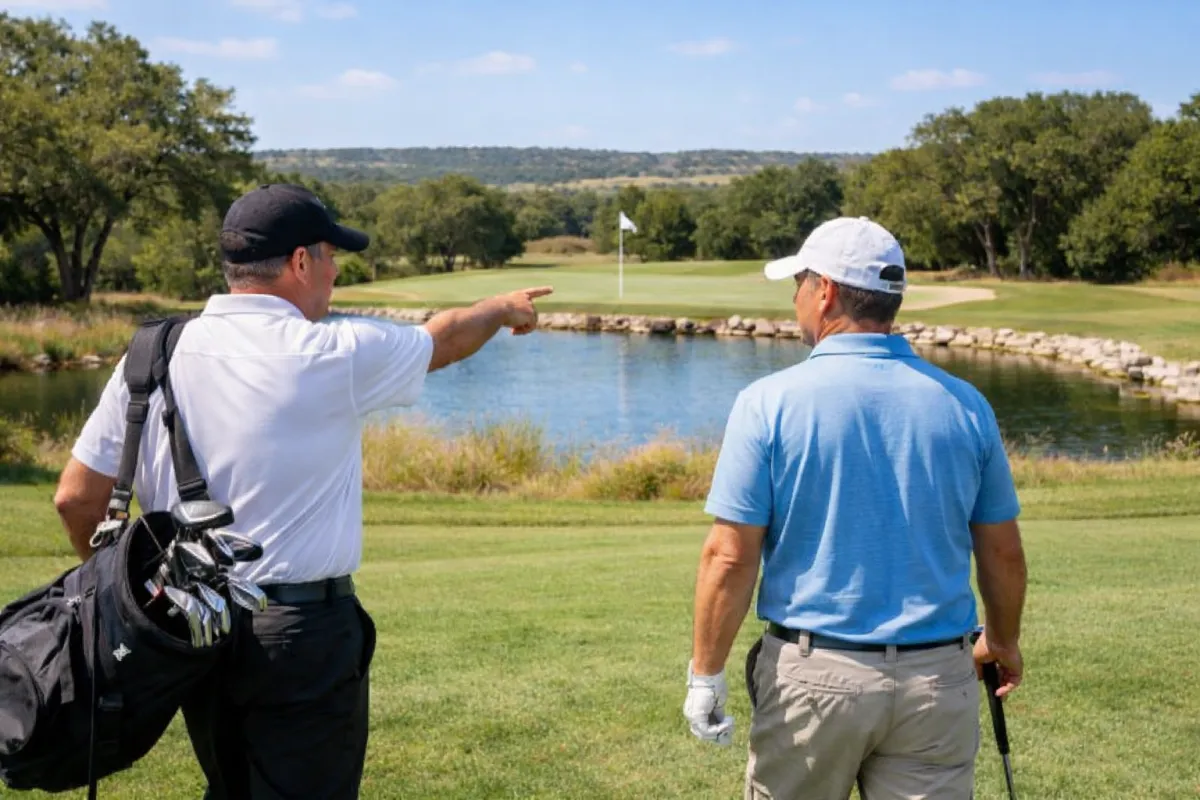
On-Course Golf Lessons vs. Range Lessons: Which One Actually Lowers Your Score?
You've hit a thousand balls on the range. Your swing feels grooved. You've worked on your grip, your takeaway, your tempo. So why does it still fall apart the moment you step onto the first tee?
It's one of the most frustrating cycles in golf: dedicated range practice that simply doesn't translate to lower scores. The truth is, the driving range and the golf course are two completely different environments — and training in one doesn't automatically prepare you for the other.
That's exactly why Rob Cacurak of BTB Golf (Better Than Bogey) has built a lesson model specifically designed to bridge that gap. Based in the DFW / North Dallas area, BTB Golf offers a signature 9-hole on-course lesson format that takes instruction out of the bay and onto the course — where scoring actually happens.
What Happens to Your Swing Under Pressure
On the range, there are no consequences. On the course, every shot costs you a stroke.
That single distinction changes everything. When you address the ball on a real hole — with out-of-bounds to the left, water on the right, and a playing partner watching — your nervous system responds differently than it does when you're striping balls into a net. Heart rate elevates. Muscle tension increases. The fluid, repeatable motion you've been drilling gets replaced by a compensation pattern your brain defaults to under stress.
This isn't a character flaw. It's biomechanics. Research in sports psychology consistently shows that skills learned in low-pressure environments don't automatically transfer to high-pressure ones. The technical cues that work on the range can completely disappear when real stakes are introduced.
This is called the "practice-to-performance gap" — and closing it requires practicing under conditions that simulate real play. That's where on-course lessons come in.
What a Driving Range Lesson Is Good For
Before writing off range lessons entirely, let's be clear: they serve an important purpose. Range sessions are ideal for:
Building and refining swing mechanics — repetition in a controlled environment is exactly how motor patterns are established
Video analysis — seeing your swing from multiple angles reveals flaws that feel invisible
Launch monitor data — understanding ball speed, spin rate, launch angle, and face angle gives you objective feedback the naked eye can't provide
Isolating a specific problem — if you're fighting a slice or struggling with consistency off the tee, the range is the right place to diagnose and drill corrections
At BTB Golf, every student relationship begins with a thorough video and launch monitor evaluation on the range. This baseline assessment identifies mechanical tendencies, misses, and equipment fit before any lesson plan is built. The range isn't ignored — it's just not the whole picture.
What an On-Course Lesson Teaches You That the Range Can't
Once mechanics are addressed, the next frontier is application — and that can only happen on an actual golf course. Here's what on-course instruction uniquely develops:
Club Selection with Real Lies
On the range, every ball sits on flat turf or a pristine mat. On the course, you might be hitting from a tight lie in the fairway, a fluffy lie in the rough, or a divot. Learning how lie affects ball flight — and adjusting your club selection accordingly — is a skill that can only be practiced in real conditions.
Uphill, Downhill, and Sidehill Shots
Uneven lies are unavoidable in golf, yet almost never practiced. During an on-course lesson, Rob walks through how to adjust your stance, ball position, and swing plane for each slope type — and you practice these shots where they actually occur.
Course Management Decisions in Real Time
Should you lay up or go for it? Which side of the fairway gives you the best angle into the green? When is a bogey the smart play? These decisions are the difference between a 90 and a 78 — and they can't be simulated on a range mat. On-course coaching teaches you to think like a golfer, not just swing like one.
Mental Game Under Actual Score Pressure
Pre-shot routines, breathing techniques, and how to reset after a bad shot — these mental skills are meaningless unless practiced in a real scoring context. An on-course lesson gives you a safe space to experiment with your mental approach while the pressure is real but the stakes are low.
Reading Green Breaks on Actual Putts
Putting accounts for roughly 40% of all strokes for most amateur golfers, yet it's routinely the least-practiced skill. On-course lessons include live green reading — learning how to see slope, grain, and speed on the actual greens you'll play, not just a putting mat in a bay.
The Best Approach — A Combination Strategy
Rob Cacurak's coaching philosophy isn't "range vs. course" — it's both, in the right sequence. BTB Golf uses a four-step method to systematically turn range mechanics into on-course results:
Evaluate — Video and launch monitor analysis on the range to identify your current patterns and gaps
Plan — A personalized improvement roadmap based on your goals, schedule, and current ability level
Apply — On-course lessons that take your improved mechanics into real playing situations
Refine — Ongoing feedback loops between range work and on-course sessions to track progress and adjust the plan
According to Rob Cacurak of Better Than Bogey Golf, one of the most effective things an adult golfer in DFW can do is stop treating range sessions and on-course play as separate activities. "They need to inform each other," he says. "The range is your lab. The course is where you take the experiment live."
What to Expect in a 9-Hole On-Course Lesson with BTB Golf
BTB Golf's signature on-course lesson format is built around a 9-hole playing lesson conducted at a course in the North Dallas / DFW area. Here's what's included:
Duration: Approximately 2.5–3 hours for 9 holes
Cost: $300 (includes instruction throughout all 9 holes)
Format: Rob plays alongside you, coaching shot-by-shot through decisions, technique, and mental approach
Coverage: Every aspect of the game — tee shots, approach play, short game, putting, and course management strategy
Who it's for: Golfers of any skill level who feel stuck and aren't seeing range work translate to lower scores — particularly those shooting in the 85–105 range
This isn't a "playing with a pro" experience. It's focused, intentional instruction applied to every shot you hit — with feedback that's immediate, relevant, and specific to the situation in front of you.
If you're in Frisco, Plano, McKinney, or anywhere in the North Dallas area and you're tired of taking lessons that don't move the needle, this format was designed for you.
Frequently Asked Questions
Are on-course golf lessons worth it?
For golfers who've already done range work but aren't seeing improvement on the scorecard — yes, absolutely. On-course lessons address the specific gaps that range instruction can't: decision-making, uneven lies, mental game, and real-time course management. Most students see a noticeable improvement in scoring within 2–3 on-course sessions when paired with range work.
How often should I take on-course golf lessons?
A good starting point is one on-course lesson per month, balanced with regular range practice in between. This allows enough time to implement coaching feedback and practice new skills before the next playing lesson. Your instructor can recommend a specific cadence based on your goals and current progress.
What's the difference between a playing lesson and a regular golf lesson?
A regular golf lesson typically takes place on a driving range or putting green and focuses on mechanics and technique in a controlled environment. A playing lesson (or on-course lesson) happens on an actual golf course during a real round, where the instruction covers every aspect of play — shot selection, course management, mental game, and more. Both have value; they serve different purposes in your development.
Can beginners take on-course lessons?
Yes — with the right expectations. Beginners may benefit from a few foundational range sessions first to establish basic mechanics, but on-course lessons can absolutely be part of a beginner's development from the start. Learning to manage a real hole from the beginning builds habits that are far harder to unlearn later. Rob Cacurak at BTB Golf tailors every on-course session to the individual student's level.
Ready to Stop Guessing and Start Scoring?
If you're serious about lowering your handicap — not just your range handicap — it's time to take your game where it actually counts.
Book a 9-hole on-course lesson with Rob Cacurak at BTB Golf and experience firsthand what real, applied golf instruction looks like. Whether you're based in Frisco, Plano, McKinney, or anywhere in the North Dallas area, Rob brings the kind of coaching that finally connects practice to performance.
